A Dreamer's Decision - MIT Reality Hack
A VR story that listens — talk to characters and shape the ending.
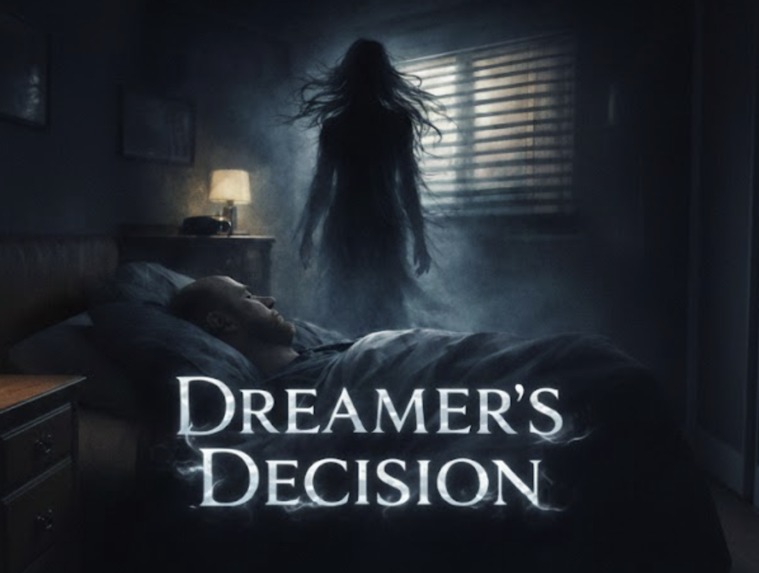
Responsive spatial narrative and conversational AI exploring the liminal state of dreams.
A Dreamer's Decision is an interactive VR experience that reframes the terrifying phenomena of sleep paralysis into a safe, responsive dialogue. By merging stereoscopic video, spatial computing, and conversational AI, we created a deeply immersive psychological journey.
• Implicit Interaction: Progression is driven by environmental responses, gaze, and hand-tracked lighting rather than traditional UI. • Multi-modal Storytelling: Seamlessly transitions between 3D stereoscopic video, a fully modeled 6DoF environment, and 360-degree video spaces. • Conversational AI Therapist: Integrates Google Gemini Flash to power a real-time, context-aware dialogue with an apparition, turning fear into existential reflection.
Sleep paralysis has no safe space to be explored.
The liminal state between dreaming and waking (e.g., sleep paralysis) is an intensely physical and terrifying experience that lacks a safe medium for exploration. The UX challenge was translating this psychological state into a spatial narrative where fear feels responsive rather than passive, without relying on traditional UI or explicit instructions.
Guide emotion through light, gaze, and presence.
I focused on Atmospheric Wayfinding and Environmental Response. Instead of explicit menus or prompts, I designed interactions driven by presence. By utilizing Meta XR hand-tracking (attaching a spotlight to the user's hand) and proximity-based entity behavior, the goal was to guide the user's emotional state purely through spatial motion, lighting, and pacing.
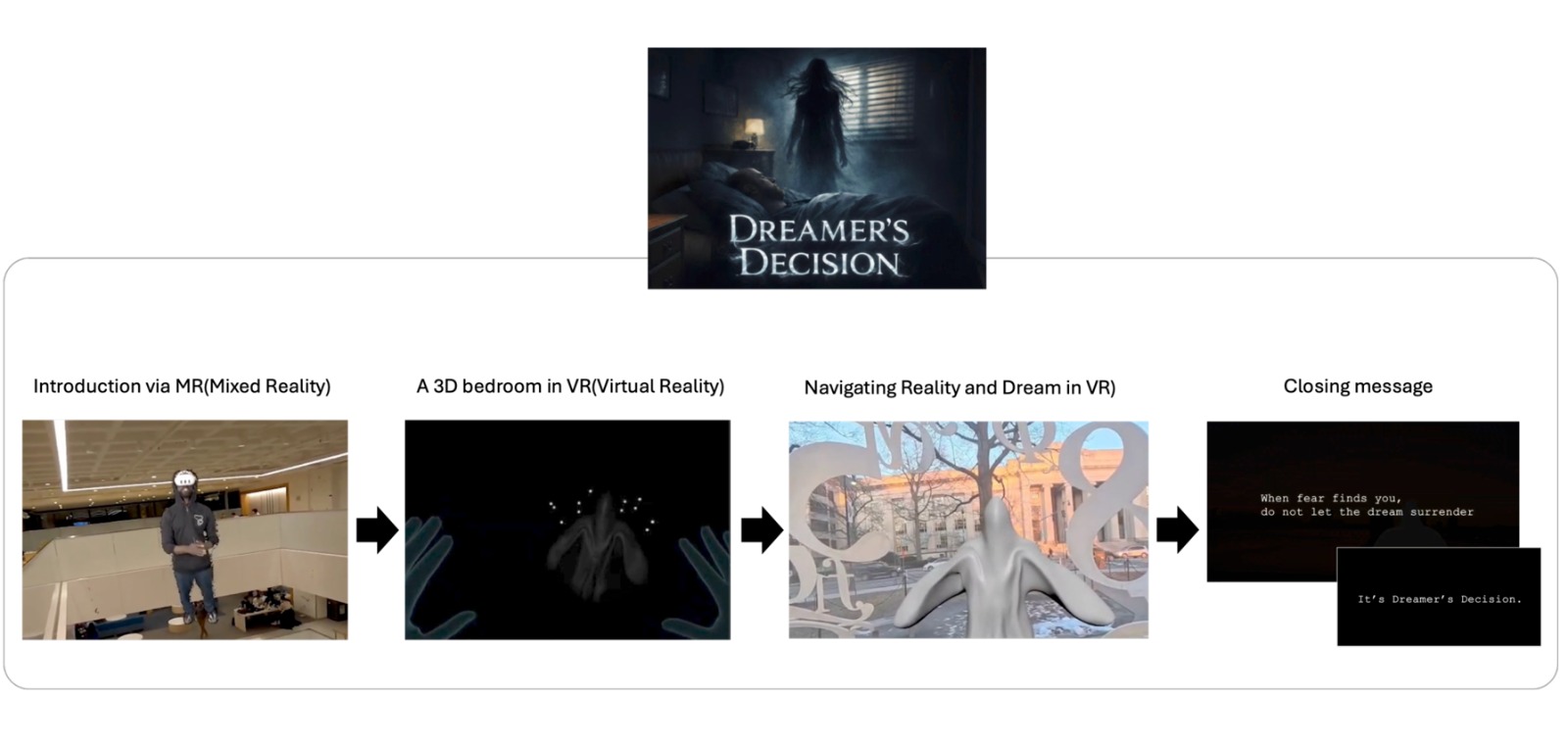
A multi-modal XR dialogue with the apparition.
Developed a multi-modal XR experience in Unreal Engine 5.5 for Quest 3. I engineered a pipeline that integrates stereoscopic chroma-keyed live-action video (custom UV mapping for 3D depth), 360-degree immersive environments, and a conversational AI (Convai + Gemini Flash) acting as an ethereal therapist. We also deployed a WebAR entry experience using the STYLY platform for accessible onboarding.
Demo
Reframing fear as conversation — in spatial form.
Successfully shipped an end-to-end spatial narrative where progression relies entirely on environmental feedback. Overcame complex XR rendering challenges and validated that responsive, immersive motion design can effectively reframe user psychology and fear within a virtual space.